
Dawood Cooling Systems · Dubai · HVAC Wholesale
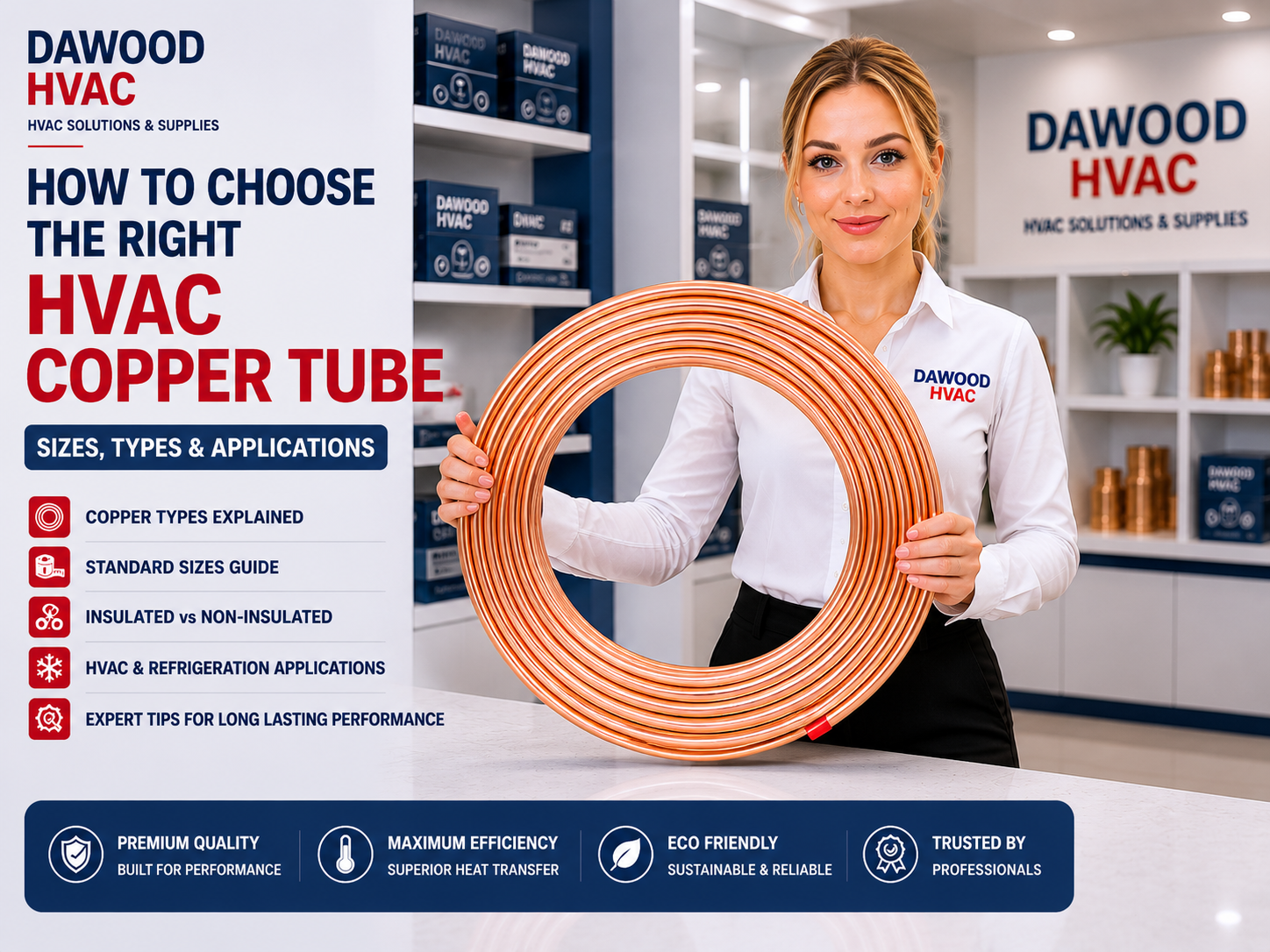
How to Choose the Right HVAC Copper Tube —
Sizes, Types & Applications Explained
Copper tube is the backbone of every HVAC and refrigeration installation. The wrong size or type costs you callbacks, system inefficiency, and premature failures. This guide covers everything Dubai’s HVAC professionals need to know.
📏 Standard Sizes Guide
🧊 Insulated vs Non-Insulated
❄️ HVAC & Refrigeration Applications
⚙️ Expert Tips for Long-Lasting Performance
Copper tube is the one material that runs through every HVAC installation in Dubai — from a small 1-ton split AC in a Deira apartment to a large commercial chiller plant in a Downtown tower. It carries refrigerant between the indoor and outdoor units, connects compressors to condensers in refrigeration systems, and handles chilled water distribution in large commercial buildings. Getting the copper specification right is not a minor detail — the wrong size, wrong wall thickness, or wrong type for the application is a reliable way to create a system that underperforms, leaks, or fails ahead of time.
Dawood Cooling Systems supplies a complete range of copper coils, lengths, and fittings for the UAE HVAC and refrigeration market from our Deira warehouse. This guide covers the five key areas every HVAC professional in Dubai needs to understand about copper tube selection and use.
💡 Copper tube sizing in HVAC is always OD (outside diameter), not ID. When specifying or ordering copper for AC work — 1/4″, 3/8″, 1/2″, 5/8″, 3/4″ — these are outside diameter measurements. This is the universal standard in the HVAC trade. Plumbing copper uses different wall thicknesses and different sizing conventions — do not substitute plumbing copper in HVAC refrigerant line applications.
1. Copper Types Explained — ACR, Dehydrated, and Coil vs Length
Not all copper tube sold in the UAE market is suitable for HVAC and refrigeration use. Understanding the distinction between ACR-grade copper and general-purpose copper — and the difference between coiled and straight lengths — is the starting point for any copper tube specification.
ACR Copper (Air Conditioning & Refrigeration Grade)
ACR-grade copper tube is manufactured, cleaned, and sealed specifically for refrigerant line use. It is dehydrated internally — moisture and residue free — and sealed at both ends to prevent contamination during storage and transport. This is the only copper tube type that should be used for refrigerant lines in HVAC and refrigeration systems. Using general-purpose or plumbing copper introduces moisture and contamination into the refrigerant circuit, leading to acid formation and compressor failure over time.
Copper Coils (Pancake Coils)
Soft-drawn copper supplied in coiled form — typically 15m, 30m, or 50m rolls. Coil copper is the standard for residential and light commercial split AC line-sets because it can be bent and routed through walls and ceiling voids without joints. The soft-drawn temper allows on-site bending to radius without cracking. Coil copper is used for liquid and suction lines in split AC installations — the most common copper application in Dubai’s residential sector. Dawood stocks coil copper in all standard HVAC sizes from Maxron, Sigma, and Westron® brands.
Straight Copper Lengths (Hard Drawn)
Hard-drawn copper supplied in straight lengths — typically 3m or 6m sticks. Used for commercial refrigeration systems, chiller plant room pipework, and any installation where straight runs with brazed fittings are preferred over bent coil. Hard-drawn copper cannot be bent on site — changes in direction require brazed elbows or bends. The harder temper provides greater structural rigidity for exposed or hanging pipework runs.
Wall Thickness — Type K, L, and M
ACR copper is available in different wall thicknesses. For HVAC refrigerant lines, the standard specification is equivalent to Type L wall thickness — adequate for the operating pressures of R22, R410A, and R32 systems. Type K (thicker wall) is used in high-pressure commercial refrigeration applications. Never use Type M (thinnest wall, intended for low-pressure water service) for refrigerant lines — it does not have adequate wall thickness for the operating pressures involved.
2. Standard Copper Tube Sizes for HVAC — Complete Size Guide
HVAC copper tube sizing follows imperial OD measurements — 1/4″, 3/8″, 1/2″, 5/8″, 3/4″, and 7/8″ are the sizes most commonly used in Dubai’s AC and refrigeration market. Each size has a defined application range based on system capacity and whether it is carrying liquid or suction refrigerant.
💡 Liquid lines are always smaller than suction lines. In a standard split AC installation, the liquid line (from condenser to evaporator, carrying high-pressure liquid refrigerant) is the smaller pipe — typically 1/4″ or 3/8″. The suction line (from evaporator to compressor, carrying low-pressure vapour) is always the larger pipe — 3/8″ to 5/8″ depending on system capacity. Reversing these or using equal sizes on both lines is a common installation error that causes system performance problems.
3. Insulated vs Non-Insulated Copper — When to Use Which
In Dubai’s climate, the question of copper insulation is not optional — it is a fundamental performance and safety requirement. Dubai’s ambient temperatures and extreme humidity levels make uninsulated suction lines a serious problem in any exposed or semi-exposed installation.
Insulated Copper — Always Use on Suction Lines
The suction line carries cold, low-pressure refrigerant vapour — typically 5–10°C — through Dubai’s hot, humid ambient environment. An uninsulated suction line in a Dubai installation picks up heat continuously from the surrounding air, reducing system efficiency significantly and causing condensation that drips onto ceilings, walls, and floors. All suction lines must be insulated with closed-cell foam insulation — minimum 13mm wall thickness for normal applications, 19mm for long line runs or high-ambient roof installations.
Liquid Line Insulation
The liquid line carries warm high-pressure liquid refrigerant and does not have the same condensation risk as the suction line. In concealed installations (inside walls or ceiling voids), liquid lines are often run without insulation. In exposed outdoor or rooftop runs in Dubai’s direct sun, insulating the liquid line prevents solar heat gain that increases the refrigerant’s subcooling loss — particularly important for long line runs where liquid flashing before the expansion valve can cause system performance problems.
Pre-Insulated Copper Coils
Pre-insulated copper coils — copper tube supplied already wrapped in closed-cell foam insulation — are widely used in UAE split AC installations for speed and consistency of insulation application. Westron® insulated copper coils are available from Dawood in standard sizes. Pre-insulated coils reduce site labour and ensure consistent insulation wall thickness throughout the line-set run — particularly valuable in long or complex routing installations.
Insulation in Dubai’s Outdoor Environment
Standard black foam insulation degrades in direct UV sunlight — Dubai’s intense solar radiation will crack and disintegrate unprotected insulation within one to two seasons. All outdoor copper line insulation must be UV-resistant (grey or aluminium-jacketed type), or protected by aluminium cladding or UV-resistant tape. Degraded insulation on outdoor runs is one of the most common causes of progressive system efficiency loss in Dubai’s residential and commercial AC systems.
4. HVAC & Refrigeration Applications — Which Copper for Which Job
Different HVAC and refrigeration applications have different copper tube requirements. Selecting the correct specification for the application avoids undersized lines that restrict flow, oversized lines that cause oil return problems, or incorrect wall thickness that fails at operating pressure.
Residential Split AC — Dubai Standard
The most common application in Dubai’s residential market. A standard 1–2 ton split AC installation uses 1/4″ liquid line and 3/8″ suction line copper coil — both pre-insulated or insulated on site. For 2.5–3 ton systems: 3/8″ liquid, 5/8″ suction. Always verify against the outdoor unit’s specification plate — some brands specify different line sizes. Dawood stocks matched coil pairs in common sizes.
Commercial Ducted & Cassette AC
Commercial systems from 3 to 10 ton typically use 3/8″ to 1/2″ liquid lines and 5/8″ to 7/8″ suction lines. Line sizing for commercial systems must be verified from the equipment manufacturer’s data — different brands and refrigerants specify different line sizes for the same nominal capacity. Always follow the manufacturer’s line sizing table rather than estimating from experience.
VRF / VRV Multi-Split Systems
VRF systems use complex refrigerant distribution networks with main trunk lines and branch lines to multiple indoor units. VRF copper sizing is governed strictly by the manufacturer’s pipe sizing tables — trunk, sub-trunk, and branch lines all have specific size requirements based on total connected capacity and distance. Never substitute different sizes without consulting the VRF design data — incorrect pipe sizing voids warranties and causes system faults.
Commercial Refrigeration — Cold Rooms
Cold room and commercial refrigeration installations use hard-drawn copper straight lengths with brazed fittings. Line sizes depend on the refrigerant type (R404A, R22, R134a), system capacity, and run length. Oil return velocity is a critical sizing factor in refrigeration systems — undersized suction lines in refrigeration lead to oil logging at the evaporator and eventual compressor oil starvation. Sizing must account for oil return, not just pressure drop.
Chilled Water Pipework
Large commercial chiller systems use chilled water distribution, not direct refrigerant pipework between the central plant and the FCUs. Chilled water pipework in the UAE typically uses carbon steel or copper in larger diameters — from 1″ upwards. This is a different application from split AC refrigerant lines and uses different sizing methods based on water flow velocity and pressure drop rather than refrigerant vapour density.
Domestic Refrigerator & Freezer Service
Domestic refrigerator compressor replacement and circuit repair uses small-diameter copper tube — typically 3/16″ or 1/4″ — and requires capillary tube for the expansion device rather than thermostatic expansion valves. Capillary tube selection (length and ID) is critical for correct refrigerant flow in domestic appliances. Dawood stocks capillary tube and small-diameter copper for domestic appliance service work.
🔧 Dawood Cooling Systems — Deira, Dubai
Copper coils, lengths & fittings — all sizes from Deira stock
1/4″ · 3/8″ · 1/2″ · 5/8″ · 3/4″ · 7/8″ — Maxron, Sigma, Westron®, Mueller, Maksal brands
5. Expert Tips for Long-Lasting Copper Tube Performance
Copper tube installed correctly lasts the lifetime of the system. Copper installed poorly — wrong bending technique, contaminated joints, or improper support — fails in months. These are the most important field practices for ensuring copper tube installations in Dubai’s HVAC market perform as they should.
Brazing — Not Soldering
All refrigerant copper joints must be brazed — not soldered. Silver brazing rod (typically 5–15% silver content, such as Harris or Westron® brazing rod) at temperatures of 650–850°C produces a joint with the mechanical strength and leak-tightness required for refrigerant pressures. Soft solder (used in plumbing) melts at much lower temperatures and cannot withstand refrigerant operating pressures — a soft-soldered refrigerant joint is a guaranteed future leak. Dawood stocks Harris and Westron® brazing rods in all grades.
Nitrogen Purge When Brazing
When brazing copper in a refrigerant system, always purge with dry nitrogen flowing through the pipe at low pressure (1–2 PSI) during the brazing operation. Heating copper in the presence of air causes copper oxide scale to form on the interior wall — this scale breaks off during operation, circulates through the system, and blocks the expansion valve or scores the compressor. Nitrogen purge during brazing is a non-negotiable requirement for a clean refrigerant circuit.
Correct Bending Technique
Copper coil should be bent using a proper tube bender — not by hand or by bending over a knee. Hand-bending soft copper collapses the tube wall at the bend, reducing the internal cross-sectional area and creating a permanent restriction in the refrigerant circuit. A tube bender with the correct radius die for each pipe size produces a clean bend without kinking or wall thinning. This is a basic requirement — the cost of a decent tube bender is recovered in avoided callbacks.
Pressure Test Before Vacuuming
After completing all copper joints and before pulling vacuum, pressure test the complete refrigerant circuit with dry nitrogen to at least 1.5 times the system’s maximum operating pressure — typically 400–600 PSI for R410A systems. Hold the test pressure for a minimum of 30 minutes and check for pressure drop. Never pressure-test with refrigerant gas or with oxygen or compressed air. Oxygen in a pressurised refrigerant system is an explosion risk. Only dry nitrogen for pressure testing.
Deep Vacuum — 500 Microns Minimum
After pressure testing, evacuate the system to 500 microns or below before charging. Dubai’s coastal humidity means moisture enters an open copper circuit rapidly — a circuit that has been open during installation or a compressor replacement must be thoroughly dehydrated by deep vacuum before refrigerant is introduced. A two-stage vacuum pump with a proper vacuum gauge (not a manifold gauge, which cannot read below 29 inHg accurately) is required. Triple-evacuation with nitrogen breaks provides maximum moisture removal.
Pipe Support and Vibration Isolation
All copper refrigerant lines must be properly supported at regular intervals — typically every 1.0–1.5m for horizontal runs — to prevent vibration-induced fatigue cracking at joints and bends. In Dubai’s high-rise buildings where copper runs through structural walls and slabs, flexible sections or vibration isolation clamps should be installed near the compressor to prevent vibration transmission from the outdoor unit into the piping. Unsupported copper lines vibrating against wall surfaces are a reliable source of refrigerant leaks within 2–3 years.
Copper Tube Brands Available from Dawood — Dubai
Dawood Cooling Systems stocks copper coils, straight lengths, and fittings from established brands used across Dubai’s HVAC and refrigeration sector. Copper quality directly affects the cleanliness of the refrigerant circuit — always source ACR-grade copper from a reputable supplier with a verified supply chain.
Maxron Copper Coils
ACR-grade copper coils in 1/4″, 5/16″, 3/8″, 1/2″, 5/8″, and 3/4″ sizes. Available in standard coil lengths. Maxron copper is widely used across UAE HVAC contractors for residential and light commercial split AC line-set work. Available from Dawood in both plain and pre-insulated versions.
Sigma Copper Coils & Lengths
Sigma copper coils and straight lengths in standard HVAC sizes. Sigma is a trusted brand for the UAE refrigeration and AC market, particularly for 5/8″ and 3/4″ sizes used in commercial AC and refrigeration applications. Available from Dawood Deira stock.
Westron® Insulated Copper
Pre-insulated copper coils from Dawood’s own Westron® brand — copper tube with closed-cell foam insulation applied at the factory for consistent insulation wall thickness. Used widely for residential split AC line-sets where speed of installation is valued. Available from Dawood in standard sizes.
Mueller & Maksal
Mueller is an American-manufactured copper brand used in precision commercial refrigeration and high-specification HVAC projects where documented material origin is required. Maksal copper coils and lengths for commercial applications. Both available through Dawood for contractors and projects requiring premium-grade copper specification.
Frequently Asked Questions
Can I use plumbing copper tube for HVAC refrigerant lines?
No — and this is a common mistake that causes long-term system problems. Plumbing copper is not dehydrated or sealed at the point of manufacture, and its internal surface condition is not held to the same standard as ACR-grade copper. Residual moisture and drawing compound inside plumbing copper introduced into a refrigerant circuit causes acid formation, filter-drier blockage, and eventually compressor valve and motor damage. Always use ACR-grade copper — sourced from a reputable HVAC wholesaler like Dawood — for any refrigerant piping application.
What size copper do I need for a standard 1.5 ton split AC in Dubai?
A standard 1.5 ton (18,000 BTU) split AC typically uses 1/4″ (6.35mm) liquid line and 3/8″ (9.52mm) suction line. However, always verify against the outdoor unit’s specification plate or installation manual — different brands specify different line sizes, and some 1.5 ton units specify 3/8″ liquid line for longer line set runs. Both lines should be insulated with closed-cell foam — the suction line with 13mm minimum wall insulation. For runs exceeding 10m, consider 19mm insulation on the suction line given Dubai’s ambient heat gain.
How long can a split AC line-set be in a Dubai high-rise installation?
Maximum line-set length depends on the specific AC model and manufacturer specifications — always check the installation manual. As a general guide, most residential split AC units are rated for up to 15–25m equivalent line length. Beyond this, additional refrigerant charge is required (specified in grams per additional metre in the installation manual), and larger line sizes may be recommended. Very long line runs — above 30m — also require careful attention to vertical height differences between indoor and outdoor units, which affect oil return to the compressor.
Do you supply copper fittings and brazing rods alongside the copper tube?
Yes — Dawood stocks a complete range of copper and brass fittings (elbows, tees, couplings, reducers, flare fittings) alongside Harris and Westron® brazing rods in all grades. You can collect your complete installation copper requirement — tube, fittings, brazing rods, and insulation — in one visit to our Deira location, or we can arrange delivery across Dubai. WhatsApp us your materials list and we will confirm availability and pricing.
Related Pages
- Copper Coils — Browse All Sizes & Brands
- Copper Pipe Fittings — elbows, tees, couplings, flare fittings
- Insulated Copper — pre-insulated coils for split AC
- Brazing Rods — Harris and Westron® silver brazing rod
- Compressors — matched to your refrigerant and system type
- Refrigerant Gases — R22, R410A, R32, R404A and more
- HVAC Tools — tube benders, flaring tools, manifold gauges
- Blogs & News — more technical guides from Dawood
Order HVAC Copper Tube in Dubai — All Sizes from Deira Stock
Copper coils, straight lengths, pre-insulated copper, brass fittings, and brazing rods — complete copper installation materials in stock at Dawood Cooling Systems, Deira. All standard HVAC sizes from 1/4″ to 7/8″. Maxron, Sigma, Westron®, Mueller, and Maksal brands. WhatsApp your requirement for same-day supply.
📞 +971 56 544 2853 · ✉ dawooddcs20@gmail.com · Deira, Near Union Metro Station, Dubai · Mon–Sat 8AM–9PM


Add comment